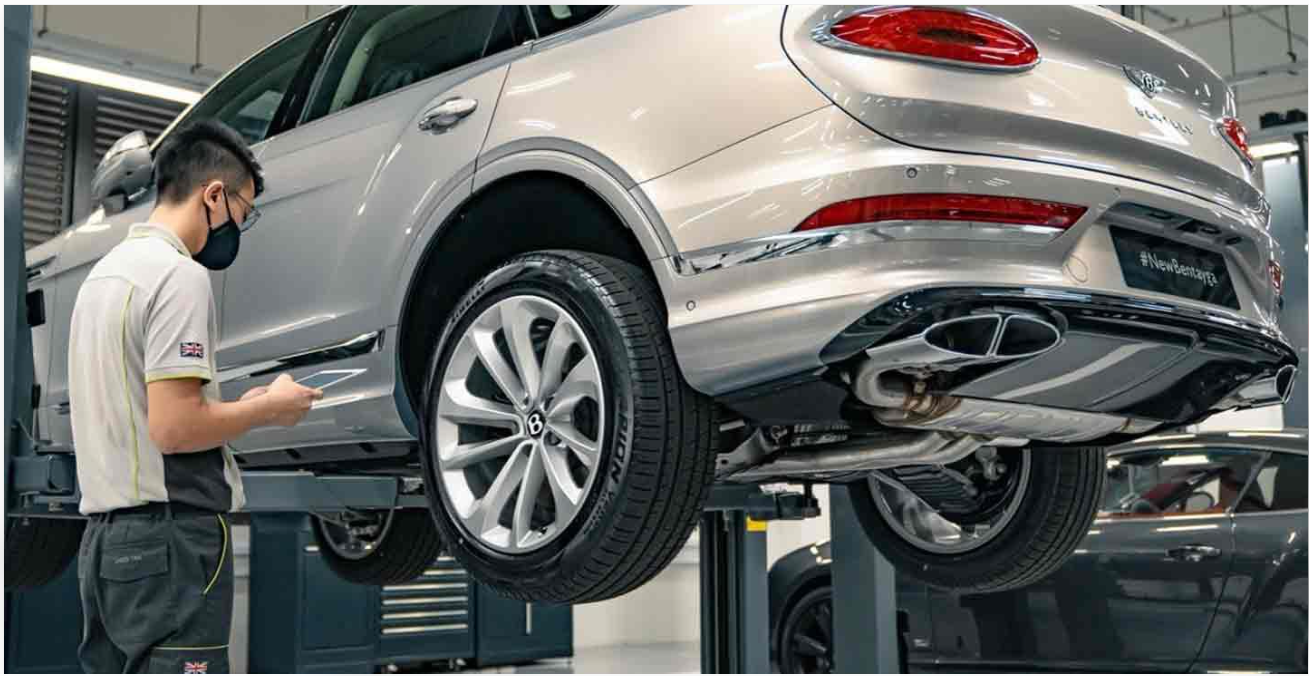

Bentley Suspension Diagnostics Repair & Maintenance
Looking for reliable Bentley suspension repair in Dubai? German Auto Lab.ae provides professional Bentley suspension inspection, diagnostics, repair, and maintenance services.
Whether your Bentley has an air suspension warning, uneven ride height, unusual suspension noises, or poor handling, our technicians can inspect the vehicle, identify the cause, and recommend a suitable repair.
We focus on accurate diagnostics, quality workmanship, and clear recommendations to help maintain your Bentley's suspension performance, driving comfort, and road stability.
Bentley Suspension Repair for All Models
Signs Your Bentley May Need Suspension Repair
- Suspension warning light on the dashboard
- Uneven vehicle height across axles
- Vehicle leaning to one side after parking
- Excessive bouncing when driving at highway speeds
- Knocking or rattling noises over road bumps
- Hard or uncomfortable ride
- Poor handling and cornering stability
- Air suspension failing to raise or lower
- Air suspension compressor running continuously
- Vehicle sitting unusually low on one or more corners
- Uneven tyre wear
- Steering vibration or instability
- Suspension sagging after overnight parking
- Adaptive damping not responding correctly to drive mode changes
Common Bentley Suspension Issues
1. Air Suspension Leaks
Bentley air suspension systems may develop leaks in the air springs, air lines, connections, or pressure accumulator. Common signs include vehicle lowering after parking, uneven ride height, vehicle leaning to one side, air suspension warning message, and compressor running frequently.
2. Air Suspension Compressor Failure
The air suspension compressor supplies compressed air to adjust the vehicle's ride height. A weak or damaged compressor may prevent the suspension from raising or maintaining the correct height. Common signs include vehicle unable to raise or lower, compressor running continuously, suspension warning light, slow suspension height adjustment, and compressor overheating.
3. Air Suspension Valve Block Problems
The valve block distributes compressed air to different suspension components. Faulty internal solenoid valves can affect air distribution and prevent the vehicle from maintaining the correct height. Common signs include uneven vehicle height, suspension lowering unexpectedly, air pressure problems, air suspension not responding, and compressor operating more frequently than normal.
4. Adaptive Suspension and Electronic Damping Problems
Bentley adaptive suspension systems adjust damping according to driving conditions. Faulty continuous damping control (CDC) valves, electrical connections, sensors, or control components can affect suspension performance. Common signs include suspension warning light, uncomfortable or unusually stiff ride, reduced driving stability, adaptive damping not responding correctly, and electronic suspension fault codes.
5. Worn Shock Absorbers and Struts
Shock absorbers and struts help control suspension movement and absorb road impacts. Worn components can affect ride comfort and vehicle stability. Common signs include excessive bouncing, poor handling, oil leaking from shock absorbers, uneven tyre wear, and knocking noises over bumps.
6. Ride Height Sensor Failure
Ride-height sensors monitor the vehicle's position and provide information to the electronic suspension control system. Common signs include incorrect vehicle height, suspension warning light, air suspension not adjusting properly, vehicle leaning to one side, and incorrect suspension sensor readings.
7. Suspension Pressure Accumulator Problems
The pressure accumulator stores compressed air for the suspension system. A leak or pressure-related fault can affect the operation of the air suspension. Common signs include air suspension warning, slow vehicle height adjustment, repeated compressor operation, pressure loss, and uneven suspension height.
8. Control Arm and Bushing Problems
Control arms and bushings connect suspension components to the vehicle chassis. Over time and under high ambient temperatures, rubber bushings can crack, become loose, or wear out. Common signs include clunking noises when driving, steering vibration, uneven tyre wear, poor wheel alignment, and vehicle pulling to one side.
9. Electronic Chassis and Roll Stabilisation Problems
Some Bentley models use advanced 48V electronic active roll stabilisation (Bentley Dynamic Ride) and chassis control systems to improve vehicle stability and cornering performance. Common signs include chassis warning messages, reduced cornering stability, unusual body movement, electronic suspension fault codes, and communication faults between chassis modules.
Common Bentley Suspension Fault Codes and Their Meanings
Bentley vehicles use electronic suspension management systems to monitor suspension performance, air pressure, ride height, and damping operation. When the system detects a problem, it stores a diagnostic trouble code (DTC):
| Fault Code | General Description |
|---|---|
| C103129 | Level control pressure sensor – implausible signal (outside expected range) |
| C104707 | Level control valves – mechanical malfunction / not operating correctly |
| C11AFF0 | Level control pressure accumulator – leak detected |
| C118D07 | Air suspension compressor – mechanical malfunction |
| C126001 | Level control compressor – levelling compressor fault |
| C1260F0 | Suspension compressor electronics or control communication malfunction |
| C103B13 | Air suspension system fault – check vehicle-specific diagnostic description |
| P089200 | Power relay sense circuit – intermittent fault recorded in chassis control system |
| B200FF0 | Suspension control module internal malfunction, where applicable |
| B200FF1 | Suspension control module internal malfunction, where applicable |
| B200FF3 | Suspension control module internal malfunction, where applicable |
| B200FF4 | Suspension control module internal malfunction, where applicable |
| B200FF5 | Suspension control module internal malfunction, where applicable |
| 48V-DR01 | Bentley Dynamic Ride 48V active anti-roll stabilizer actuator circuit malfunction |
The exact interpretation of Bentley-specific fault codes can vary depending on the model, suspension generation, control module, and diagnostic software. A diagnostic scan using factory ODIS or dedicated Bentley diagnostic tools is necessary to confirm the actual cause.
Bentley Suspension Control Module Diagnostics, Repair and Programming
The Suspension Control Module is the electronic computer responsible for monitoring and managing important suspension functions. Depending on the Bentley model and system generation, the suspension control unit may be identified as the Adaptive Suspension Control Unit (J197), Running Gear Control Unit (J775), or another chassis control module. It monitors and controls electronic suspension damping, air suspension compressor operation, vehicle ride height, air suspension pressure, suspension sensors, electronic damping valves, communication with other vehicle control modules, and 48V electronic roll stabilisation where fitted.
Signs of a Faulty Bentley Suspension Control Module
- Suspension warning light appearing on dashboard
- Air suspension not responding to driver mode commands
- Vehicle unable to adjust ride height
- Suspension settings not working correctly
- Vehicle lowering unexpectedly
- Adaptive damping not functioning properly
- Communication problems with diagnostic equipment
- Repeated electronic suspension fault codes
- Incorrect ride-height readings
- Suspension system entering a restricted operating mode
Bentley Suspension Control Module Repair and Programming Services
German Auto Lab.ae can help diagnose Bentley suspension control module problems through electronic diagnostics and system testing. Depending on the fault, the required service may include: Bentley suspension control module diagnostics, J197 and J775 control unit fault detection, electronic damping system inspection, suspension software inspection and programming, module coding and adaptation, CAN bus communication testing, wiring and electrical connection inspection, ride-height sensor signal testing, air suspension compressor control testing, suspension control module repair assessment, and suspension control module replacement and programming where required. Note: Not every suspension fault code means the control module is damaged. Wiring problems, faulty sensors, low battery voltage, compressor failures, air leaks, and communication interruptions can also trigger these codes. Proper testing is necessary before recommending module repair or replacement.
Our Bentley Suspension Repair Services
Why Choose German Auto Lab.ae for Bentley Suspension Repair?
Choosing an experienced workshop is important when dealing with Bentley suspension problems. At German Auto Lab.ae, we focus on: professional Bentley suspension inspection and diagnostics, experienced automotive technicians, advanced diagnostic equipment, repair solutions based on the actual problem, service for different Bentley models and suspension systems, suitable replacement parts for the required repair, clear explanations and repair recommendations, transparent pricing, and free pickup and delivery across Dubai. Our goal is to help you maintain your Bentley's suspension performance, driving comfort, and road stability.
Frequently Asked Questions
1. How much does Bentley suspension repair cost in Dubai?
The cost depends on the Bentley model, suspension type, nature of the problem, and replacement parts required. An inspection is necessary before providing an accurate repair estimate.
2. What are the most common Bentley suspension problems?
Common problems include air suspension leaks, compressor failure, faulty valve blocks, pressure accumulator leaks, worn shock absorbers, ride-height sensor faults, and electronic suspension problems.
3. What are the common Bentley suspension fault codes?
Some documented Bentayga suspension codes include C103129 for a level control pressure sensor fault, C104707 for a level control valve mechanical malfunction, C11AFF0 for a pressure accumulator leak, and C118D07 for a compressor mechanical fault.
4. What are the symptoms of a faulty Bentley suspension control module?
Symptoms may include suspension warning lights, incorrect vehicle height, air suspension not responding, adaptive damping problems, communication issues, and repeated electronic fault codes. Proper diagnostics are needed to confirm whether the module requires repair or replacement.
5. Can Bentley air suspension be repaired?
Yes. Depending on the problem, repairs may include air spring replacement, compressor repair or replacement, air leak detection, valve block inspection, and pressure accumulator repair.
6. Is it better to repair or replace Bentley air suspension?
It depends on the extent of the damage. Some air suspension problems can be fixed by replacing individual components, while severe damage may require complete assembly replacement.
7. Do you provide suspension repair for all Bentley models?
We provide suspension inspection and repair services for different Bentley models, including Bentayga, Continental GT, Continental GTC, Flying Spur, and other applicable models. Service availability depends on the vehicle and suspension system.
8. Can I still drive my Bentley if the suspension warning light is on?
It depends on the warning and vehicle condition. If the vehicle is leaning, sitting extremely low, handling poorly, or showing serious suspension problems, stop driving when safe and arrange an inspection.
9. Can a Bentley suspension control module be repaired?
Some suspension control module problems can be resolved through software updates, coding, wiring repairs, or electronic repairs. However, certain internal failures may require module replacement and programming.